What is Arabic calligraphy? The art behind every Talisma piece of jewelry
Introduction: when writing becomes jewelry
There is jewelry you wear. And there is jewelry you feel.
At Talisma, every piece is more than just an accessory: it is a name, a word, a story engraved in metal. An invisible link between a woman and her identity, between one culture and another, between the past and the present. And at the heart of this magic lies an art form over a thousand years old—Arabic calligraphy.
But what exactly is Arabic calligraphy? Where does it come from? Why is it so special? And how does Talisma transform it into unique jewelry? That is what we will explore together in this article.
Whether you are passionate about art, curious about your roots, or simply looking for the perfect personalized piece of jewelry, you have come to the right place.
1. Arabic calligraphy: a definition
Arabic calligraphy—in Arabic خط عربي (khatt 'arabi)—is the art of Arabic writing elevated to the level of artistic expression. The word khatt literally means "line" or "stroke," which says it all: in Arabic calligraphy, every stroke is thought out, measured, and felt.
Unlike the Latin script we use every day, Arabic script is cursive by nature: the letters connect to one another in a continuous movement, from right to left, like a dance on paper—or on metal. This natural fluidity is what makes Arabic calligraphy so visually powerful and so well-suited for jewelry making.
Each Arabic letter can take up to four different forms depending on its position in the word (initial, medial, final, or isolated). This complex system, far from being a constraint, is a richness: it allows for infinitely varied visual compositions, where each name becomes a unique work of art.
2. A thousand-year history: from origins to today
The origins of Arabic calligraphy
Arabic script finds its roots in the Nabataean alphabet, itself derived from Aramaic, around the 4th century. But it was with the advent of Islam in the 7th century that Arabic calligraphy took on an unprecedented artistic and spiritual dimension.
The transcription of the Quran—the divine word according to the Islamic faith—required a script worthy of its content. Calligraphers of the era then developed increasingly elaborate styles, transforming each page into a work of art. Calligraphy quickly became the major art form of the Islamic world, where figurative painting was limited by religious considerations.
An art that crosses borders
Over the centuries, Arabic calligraphy spread far beyond the Arabic-speaking world. From Andalusian Spain to Indonesia, from North Africa to the Ottoman Empire, it has enriched dozens of cultures, adapting to each while maintaining its essence.
Today, Arabic calligraphy is experiencing a true global revival. It inspires contemporary artists, fashion designers, architects—and, of course, jewelry designers.
International recognition
In December 2021, UNESCO inscribed Arabic calligraphy on the Representative List of the Intangible Cultural Heritage of Humanity. A historic recognition that establishes this art as a universal treasure, belonging to all of humanity.
3. The major styles of Arabic calligraphy
There is not just one Arabic calligraphy, but a family of styles, each with its own personality, history, and uses. Here are the main ones:
Naskh — نسخ
The most legible and widespread style. Balanced, clear, elegant. This is the style used in the press, books, and signage. Its legibility makes it a preferred choice for name jewelry, as each letter remains perfectly identifiable.
Thuluth — ثلث
Majestic and ornamental, Thuluth is the style for great occasions. It is found in mosque architecture, on palace doors, and in the illuminations of precious manuscripts. Its generous proportions and elaborate ornaments make it a prestigious style.
Diwani — ديواني
Developed at the Ottoman court in the 16th century, Diwani is the most romantic and fluid style. Its generous curves, interlaced letters, and almost musical movement make it the ideal style for personalized jewelry. It is what gives that impression of fluidity and elegance found in Talisma jewelry.
Kufic — كوفي
One of the oldest styles, characterized by its geometric and angular forms. Often used in architecture and decorative arts, it offers a more graphic and contemporary look.
Ruq'a — رقعة
The style of everyday writing in the Arab world. Simple, fast, efficient. Less ornamental than the others, but endowed with a natural and authentic charm.
At Talisma, we primarily work with styles inspired by Diwani and Naskh—to combine the romantic fluidity of the former with the elegant legibility of the latter. The result: jewelry that is both beautiful to look at and easy to read.
4. Why is Arabic calligraphy so well-suited for jewelry?
It is no coincidence that Arabic calligraphy has established itself as one of the most used art forms in contemporary jewelry. Several reasons explain this natural affinity:
The fluidity of the forms
Arabic script is cursive by nature. The letters flow into one another in a continuous movement that creates organic, almost sculptural forms. On a piece of jewelry, this movement becomes a lifeline, a visual signature that is immediately recognizable.
The uniqueness of each name
In Arabic calligraphy, every name is unique. The way the letters come together, the ligatures that form, the proportions that balance out—all of this creates a different composition for every word. Two pieces of jewelry bearing the same name will never be exactly identical.
The symbolic weight
Wearing your name in Arabic means carrying a story. For women of the North African or Middle Eastern diaspora, it is an act of identity affirmation, a tribute to their roots. For others, it is an invitation to discover a rich and fascinating culture.
The timeless aesthetic
Arabic calligraphy is not a trend. It is a millenary art that has crossed the centuries without ever aging. A piece of jewelry in Arabic calligraphy will be just as beautiful in ten years as it is today.
5. From art to jewelry: the Talisma process
Transforming a name into jewelry is not a simple copy-paste job. It is a work of precision, sensitivity, and expertise. Here is how Talisma proceeds:
Step 1: Transliteration
Everything begins with the name you entrust to us. If your name is French or from another language, it must first be transliterated into Arabic—that is to say, transcribed phonetically into the Arabic alphabet. This is a crucial step: a misplaced letter can completely change the meaning of a word in Arabic, or make a name illegible.
At Talisma, every transliteration is carefully verified. We know the subtleties of the Arabic language and we ensure that your name is rendered with accuracy and elegance.
Step 2: The calligraphic composition
Once the name is transliterated, it is composed in calligraphy. This step involves choosing the style, the proportions, and the ligatures—in short, creating the visual composition that will become your jewelry. This is where the art comes in.
Step 3: Manufacturing
The composition is then engraved or cut from gold-plated 316L stainless steel—a premium material chosen for its durability, resistance to oxidation, and lasting shine. No tarnishing, no allergies, no discoloration: your jewelry remains beautiful over time.
Step 4: Quality control
Each piece of jewelry is checked before shipping. We ensure that the calligraphy is sharp, the finishes are impeccable, and the jewelry corresponds exactly to what you ordered.
6. Our Arabic calligraphy jewelry: a collection for every story
At Talisma, we offer a wide range of personalized Arabic calligraphy jewelry for all occasions and styles:
The name necklace — the timeless classic
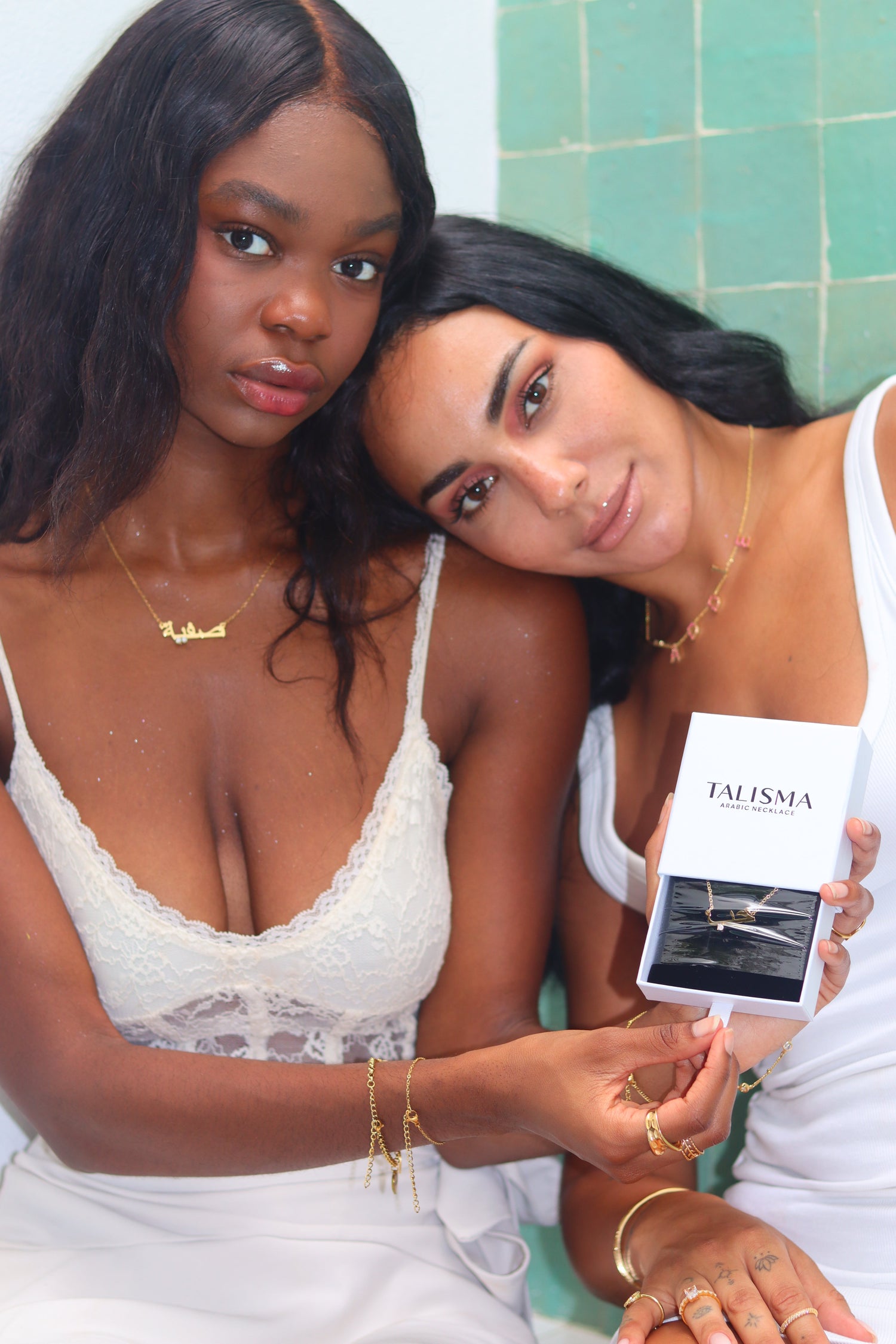
Our bestseller. Your name, in Arabic calligraphy, hanging from a gold chain. Simple, elegant, personal. The piece of jewelry you wear every day and never take off.
👉 Discover the Personalized Arabic Necklace — Arabic Calligraphy Name
The initial necklace — for those who love discretion
A single letter in Arabic calligraphy. Minimalist and refined. Perfect for those who want a piece of jewelry that is subtle but meaningful.
👉 Discover the Initial Necklace in Arabic Calligraphy
The two-name necklace — to celebrate a bond
Two names intertwined on the same piece of jewelry. That of a mother and her child, two sisters, or two soulmates. A piece of jewelry that tells a unique relationship.
👉 Discover the Personalized Two-Name Necklace
The rhinestone name necklace — for those who love to shine
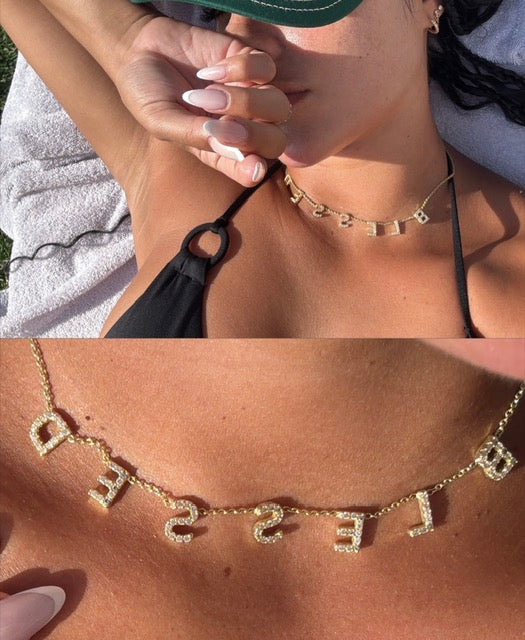
Arabic calligraphy meets glamour. Colorful rhinestones embedded in the letters of your name, for a piece of jewelry that catches the light and the eye.
👉 Discover the Personalized Rhinestone Arabic Necklace
The 925 silver necklace — for a precious piece
For those who want a piece of jewelry in real silver. Your name in Arabic calligraphy, engraved in rhodium-plated 925 silver. A piece of jewelry of jeweler's quality, to give as a gift or to treat yourself.
👉 Discover the Personalized Initial Necklace in 925 Silver
7. Wearing Arabic calligraphy jewelry: much more than a trend
In recent years, Arabic calligraphy jewelry has seen remarkable growth. We see them on social media, in fashion magazines, and on celebrities. But beyond the trend, why do so many women choose to wear their name in Arabic?
An act of identity affirmation
For many women from the North African, Middle Eastern, or African diaspora, wearing their name in Arabic is a strong statement. It is saying: "I am proud of who I am, where I come from, my language, and my culture." In a world that sometimes encourages self-erasure, it is a piece of jewelry that asserts an identity with elegance and pride.
A bridge between cultures
Arabic calligraphy fascinates far beyond the Arabic-speaking world. Women of all backgrounds choose to have their names engraved in Arabic—drawn by the beauty of the script, by cultural curiosity, and by the desire to wear something unique. Arabic calligraphy is a bridge between cultures, an invitation to dialogue and discovery.
Jewelry charged with meaning
A name is the first thing we are given. It is our most fundamental identity. Wearing it as jewelry is celebrating it, cherishing it, and making it visible. And wearing it in Arabic calligraphy gives it an additional artistic and cultural dimension.
The perfect gift
Personalized Arabic calligraphy jewelry is one of the most appreciated gifts. For a birthday, a birth, Mother's Day, a wedding, or a graduation—it is suitable for all occasions and all women. Because it is unique, because it is beautiful, and because it comes from the heart.
8. How to take care of your Talisma jewelry?
Our jewelry is made of gold-plated 316L stainless steel, a material recognized for its durability. Here are some tips to keep them beautiful for a long time:
- Avoid prolonged contact with water—remove your jewelry before swimming or taking a long shower.
- Keep it away from chemical products—perfumes, creams, and household products can alter the shine of the metal.
- Store it in its pouch—away from light and humidity, your jewelry will retain all its luster.
- Clean it gently—a soft cloth is enough to bring back its shine.
Conclusion: your name deserves to be worn as a work of art
Arabic calligraphy is not just a script. It is a philosophy of beauty, a way of saying that words deserve to be treated with grace and intention. It is an art that has crossed a thousand years of history without ever losing its magic.
At Talisma, we put this art at the service of your story. Because your name is unique. Because it deserves to be worn with pride. Because jewelry that truly reflects you changes everything.
Whether you want to treat yourself to jewelry that reflects you, or give an unforgettable gift to a woman you love, Talisma is here to transform your name into a work of art.
👉 Discover the entire Talisma collection and create your personalized jewelry today.

Leave a comment
This site is protected by hCaptcha and the hCaptcha Privacy Policy and Terms of Service apply.